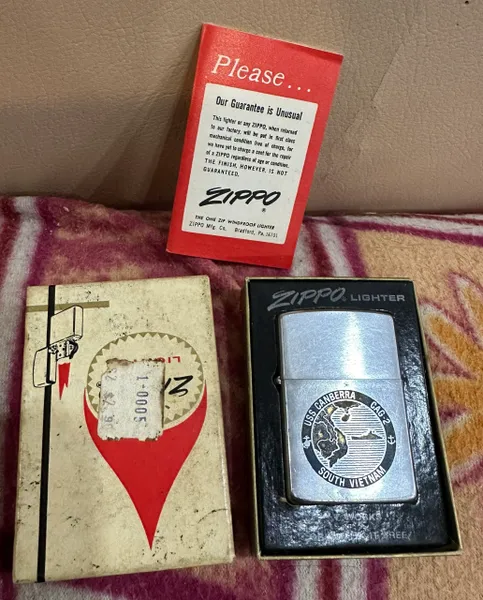
Vietnam War- Marines USS CANBERRA CAG-2 South Vietnam Navy Zippo Lighter
$500.00
Original All Vietnam War in Zippo Lighter
Short Stories :
For other ships with the same name, see USS Canberra.
USS Canberra underway on 9 January 1961 | |
History | |
United States | |
Name | Canberra |
Namesake | |
Ordered | 1 July 1940 |
Builder | |
Laid down | 3 September 1941 |
Launched | 19 April 1943 |
Sponsored by | Alice Dixon |
Commissioned | 14 October 1943 |
Decommissioned | 7 March 1947 |
Recommissioned | 15 June 1956 |
Decommissioned | 2 February 1970 |
Reclassified | CAG-2, 4 January 1952 CA-70, 1 May 1968 |
Stricken | 31 July 1978 |
Identification | Callsign: NBLS
Hull number: CA-70 |
Nickname(s) | Can-Do Kangaroo[citation needed] |
Honors and awards | |
Fate | Scrapped, 31 July 1980 |
Badge | General characteristics |
Class and type | Baltimore-class cruiser (as CA-70) Boston-class cruiser (as CAG-2) |
Displacement | 13,600 tons |
Length | 673 ft 5 in (205.26 m) |
Beam | 70 ft 10 in (21.59 m) |
Draught | 20 ft 6 in (6.25 m) |
Propulsion | Steam turbines, 4 × 615-psi boilers |
Speed | 33 knots (61 km/h; 38 mph) |
Complement | 1,142 officers and enlisted |
Armament | As CA-70: 9 × 8"/55 guns (203 mm) 12 × 5"/38 guns (127 mm) As CAG-2: 6 × 8"/55 guns (203 mm) 10 × 5 in (130 mm) guns, 12 × 3 in (76 mm) guns (76 mm), |
USS Canberra (CA-70/CAG-2)was a Baltimore-class cruiserand later a Boston-class guided missile cruiser of the United States Navy (USN). Originally to be named USS Pittsburgh, the ship was renamed before launch to honor the Australian cruiser HMAS Canberra sunk during the Battle of Savo Island. Canberrawas the first USN warship named after a foreign capital city, and one of the few named after a foreign warship not captured in battle with a USN ship.
The ship entered service in 1943 and served in the Pacific theater of World War II until she was torpedoed during the Aerial Battle of Taiwan-Okinawa and forced to return to the United States for repairs. Placed in reserve after the war, Canberrawas selected for conversion into the second guided-missile carrying warship in the USN fleet. Following the conversion, she was host to the ceremony for selecting the Unknown Soldier representing World War II in 1958, undertook an eight-month round-the-world cruise in 1960, participated in the Cuban Missile Crisis naval blockade in 1962, and was deployed to the Vietnam War on five occasions between 1965 and 1969.
Canberra underway as part of Task Force 38 in 1944
Canberra firing a Terrier missile following her Boston class conversion
Post-conversion career
Canberra was recommissioned on 15 June 1956, and homeported at Norfolk, Virginia.[3] From June until March 1957, the cruiser operated from Norfolk and through the Caribbean.[3]On 14 March, Canberra delivered President Dwight D. Eisenhower to Bermuda for a conference with Harold Macmillan, the British Prime Minister.[3] On 12 June, the cruiser served as review ship for the International Naval Review at Hampton Roads.[4] After a training cruise during July and August, Canberra was deployed to the Mediterranean for NATOOperation Strikeback.[3]
From 3 March until 24 October 1960, the cruiser made an 8-month round-the-world cruise to show the flag and demonstrate her missile capabilities to U.S. and Allied forces.[6] During the voyage, she flew the flag of Rear Admiral J. McN. Taylor, Commander of the Atlantic Fleet Cruiser Force and Cruiser Division 6. During this deployment, the ship visited the site of her Australian cruiser namesake's sinking, along with locations where the American cruiser had herself served during World War II.[6]
Canberra off the coast of South Vietnam during her 1966 WESTPAC cruise
In 1962, she sailed south from Norfolk to participate in the naval blockade during the Cuban Missile Crisis.[8] During the Vietnam War, Canberra was homeported at San Diego. She deployed to Vietnam five times from 1965 to 1969[6] where her 8-inch and 5-inch guns provided support for US troops. During the deployments in 1967 and 1968, Canberra operated north of the DMZ shelling bridges, transport routes and shore installations. On 2 March 1967, the cruiser was hit by two shells fired from ashore,[6] which caused 5 injuries and minor structural damage. On 6 April 1967, a young seaman named Doug Hegdahl was accidentally blown overboard by one of the 5-inch guns; he was captured by a North Vietnamese gunboat and imprisoned in the infamous Hanoi Hilton. Hegdahl's recollections of his time there would later serve as proof of torture committed by the North Vietnamese at POW camps. At the conclusion of her second tour of duty in April 1967, the cruiser visited Melbourne, and was in Australian waters in May for commemorations of the Battle of the Coral Sea.[6][8]
During the 1968 Tet Offensive, Canberra went south to support the troops at Hue and fired 35,000 rounds in 31 days. On 1 May 1968, Canberra returned to her original hull